As part of the 6th edition of Désertif’actions, a series of four thematic webinars was organised to foster dialogue between stakeholders and contribute to the development of common advocacy messages.
These discussions are part of the central theme of Désertif’actions 2026: how can we improve the resilience of territories — ecosystems and communities — in the face of drought?
Through complementary approaches — regional management, pastoralism, agricultural systems and regional water management — these webinars provided an opportunity to compare analyses, promote existing solutions and identify concrete levers for action.
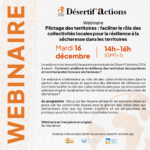
The key role of local authorities in regional governance
This webinar highlighted the central role of local authorities in anticipating and managing drought-related crises. As the authorities closest to the people and the realities on the ground, they have strong legitimacy, the capacity to act quickly and a lasting presence in the territories.
Discussions focused on the resources mobilised by local authorities to tackle droughts, the solutions proposed by operators in the field to support them, and the levers for action and advocacy needed to strengthen their capacity to manage territories sustainably in the context of climate crises.
For more information, click here to read the report (in French).
To watch the webinar again, click here (in French and English)
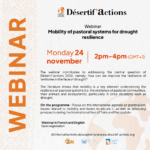
Pastoralism: mobility at the heart of resilience
Focusing on pastoral systems, this webinar highlighted that pastoral mobility is a key factor in resilience to drought. Resilience here is understood as the ability of pastoral communities, their animals and ecosystems to adapt, withstand and recover from climate shocks.
The lessons learned from national workshops held in Guinea, France and Kenya reveal shared findings: land degradation, irregular rainfall and water scarcity are weakening pastoral systems. However, pastoralism also appears to be a major lever for adaptation, contributing to ecosystem regulation, soil preservation and food security. Common advocacy messages have emerged, particularly around the recognition of pastoralism as a pillar of adaptation strategies, inclusive governance of territories and securing pastoral mobility.
For more information, click here to read the report (in French).
To watch the webinar again, click here (in French and English)
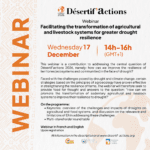
Transforming agricultural systems to cope with droughts
This webinar focused on sedentary agricultural and livestock farming systems, which are facing increasingly frequent and intense droughts. While certain practices based on agroecological principles have proven effective in strengthening the resilience of farms, their adoption remains hampered by numerous obstacles.
The discussions provided an opportunity to analyse the impacts of droughts on agricultural systems, the potential of agroecology to improve their resilience, the solutions implemented by agricultural development actors, and the levers for action and advocacy that can be activated to support the transition and promote scaling up.
For more information, click here to read the report (in French).
To watch the webinar again, click here (in French and English)
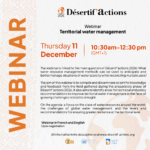
Better water management at regional level
This latest webinar focused on regional water resource management in the face of increasing shortages. The aim was to identify management methods that would enable crises to be anticipated, while reconciling the multiple uses of water.
Discussions focused on the impact of droughts on water management, the benefits of a territorial approach to strengthening resilience, solutions proposed by development actors, and the levers for action and advocacy needed to support more sustainable water management practices that are adapted to climate challenges.
For more information, click here to read the report (in French).
To watch the webinar again, click here (in French and English)