News from 24/11/2025
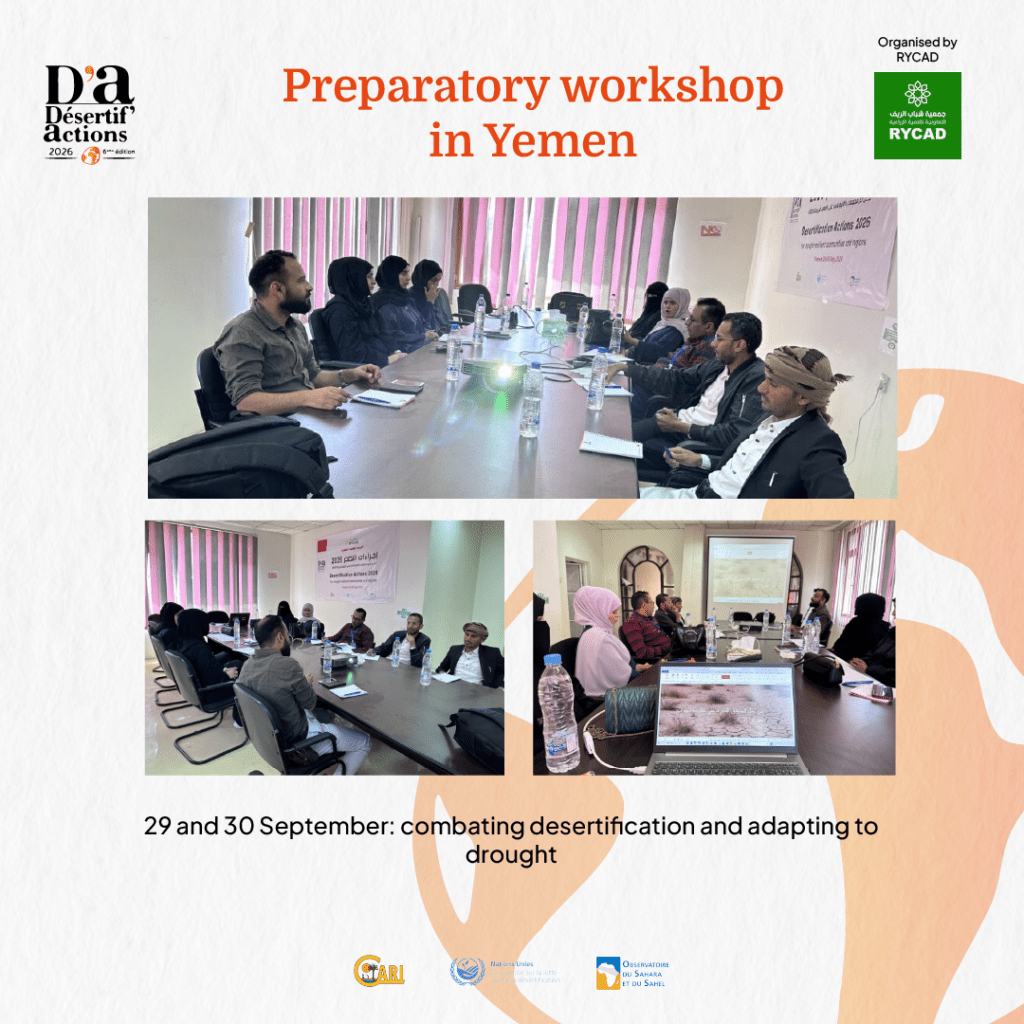
While Yemen remains one of the countries most vulnerable to climate change, marked by extreme water scarcity and accelerated land degradation, the Rural Youth Cooperative for Agricultural Development (RYCAD) organized a national workshop on September 29 and 30, 2025, dedicated to combating desertification and adapting to drought. This meeting, which consisted of an initial online day followed by an in-person session in Taiz, was part of the international Desertif’actions 2026 initiative.
Bringing together a total of 31 participants from farmers’ organizations, technical services, universities, local authorities, and community organizations, the workshop provided an opportunity to take stock of the situation and, above all, to jointly develop operational courses of action to strengthen the resilience of rural communities in the face of longer, more frequent, and more severe droughts.
Yemen: structural vulnerability to drought
With more than 90% of the country’s territory classified as arid or semi-arid, agriculture heavily dependent on rainfall and groundwater, and increasing pressure on land, drought has become a systemic crisis. Participants highlighted some worrying figures:
- renewable resources of just 83 m³ of water per capita per year,
- nearly 90% of water withdrawals for agriculture,
- acute overexploitation of certain aquifers, such as that of Sana’a, where withdrawals exceed natural recharge by more than four times.
These water tensions are compounded by land degradation, declining pastures, conflicts over use, and the collapse of traditional infrastructure such as mountain terraces.
A two-part workshop: sharing diagnosis and identifying solutions
Day 1 (online)
This first session laid the foundations for a shared diagnosis, covering:
- the state of desertification in Yemen;
- the biophysical and social mechanisms that exacerbate drought;
- the observed impacts on agriculture, pastoralism, and food security;
- the country’s commitments within international frameworks (UNCCD, NDC, adaptation plans).
Participants were divided into three groups, corresponding to the three areas of focus for the workshop:
- Transforming irrigated and rain-fed agriculture in the face of drought;
- Sustainable water resource management at the watershed level,
- Better protecting and restoring agricultural and pastoral lands.
Each group produced an initial analysis of the problems, opportunities, key actors, and relevant indicators.
Day 2 (in person, in Taiz)
The second day, held in person, allowed these diagnoses to be transformed into concrete intervention packages, developed through collaborative exercises:
- co-construction sessions,
- cross-group reviews (“gallery walk”),
- prioritization according to an impact/feasibility matrix,
- development of an initial national roadmap.
Shared findings: longer drought periods, soil depletion, and increased pressure on resources
The groups highlighted several worrying trends:
- a marked decline in crop productivity and an increase in post-harvest losses;
- decline in pastureland and soaring fodder prices;
- increasing reliance on deep wells, fueling a spiral of groundwater depletion;
- intensification of conflicts over water, pasture, and agricultural land;
- increased vulnerability of women, smallholder farmers, and mobile pastoralists;
- multiple simultaneous shocks: drought, extreme heat, dust-laden winds, and flash floods.
Stocktaking of proven practices and local solutions
Participants highlighted a set of proven local practices:
- rainwater harvesting (cisterns, small dams, check dams);
- regular maintenance of agricultural terraces;
- water-efficient irrigation (drip irrigation, controlled deficit irrigation);
- flexible crop rotations and drought-tolerant varieties;
- mobile community veterinary services;
- local water committees to organize irrigation rotations and reduce tensions;
- climate information via SMS, mobilizing young people to collect data.
Priorities for action defined by participants
At the end of the discussions, four major areas for action emerged.
1. Water and irrigation
- Support for the creation of water user associations;
- Deployment of efficient irrigation materials and techniques and local training in maintenance;
- rehabilitation of small canals, dykes, and retention dams;
- installation of groundwater level measurement points and monitoring of withdrawals.
2. Livestock farming and pastoral services
- creation of village fodder banks;
- improvement of watering points (shade, troughs, windbreaks);
- strengthening of the network of CAHWs (community animal health workers).
3. Climate services and digitalization
- launch of agricultural and pastoral alert SMS messages aligned with local calendars;
- mobilization of young people to collect agroclimatic data.
4. Financing and social protection
- Expansion of cash/food-for-assets programs for water and land restoration.
- experimentation with drought index insurance and seasonal microfinance.
Read all the recommendations in the full workshop report .