Act of 24/11/2025
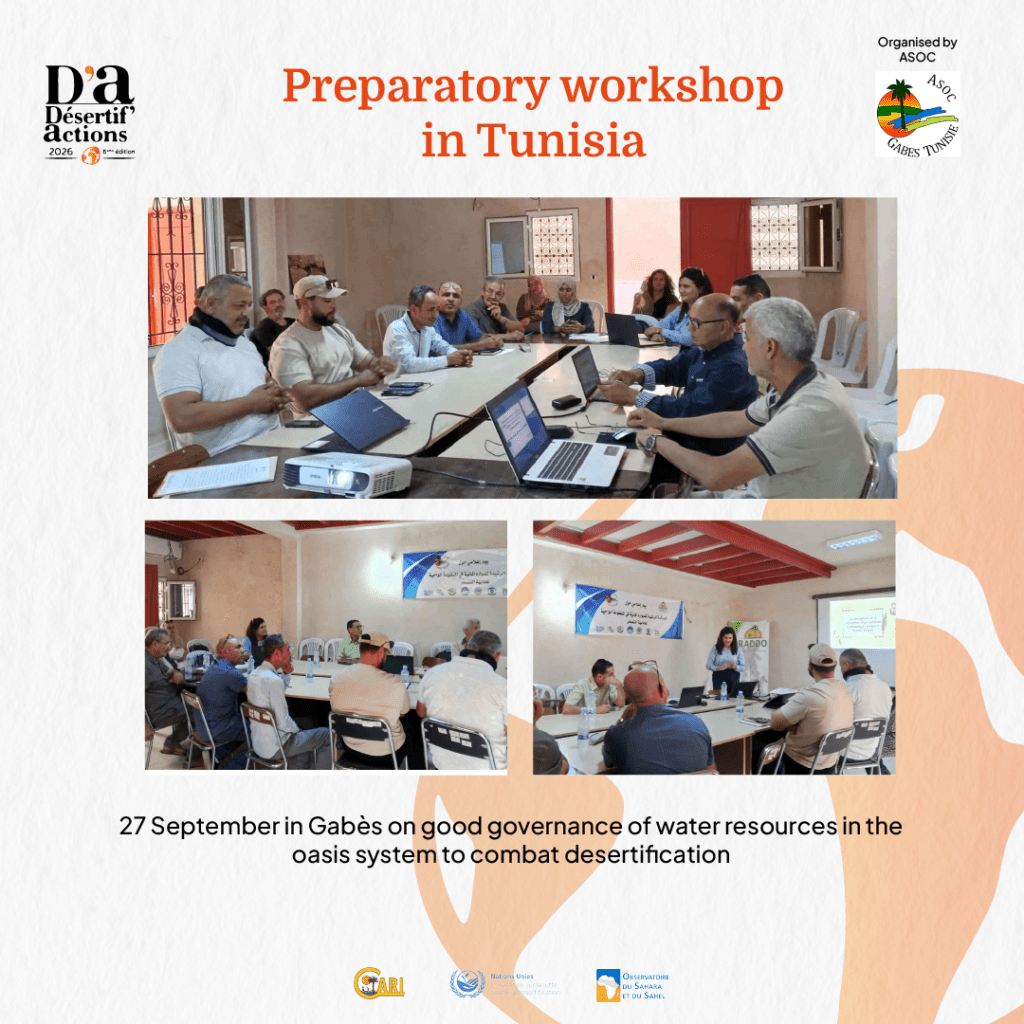
On September 27, 2025, the Association for the Safeguarding of the Chenini Oasis (ASOC) brought together a wide variety of local, regional and national actors in Gabès for a day dedicated to good water governance in oasis systems. Organized as part of the preparations for the International Desertif’actions 2026 Summit, this meeting made it possible to draw up a shared diagnosis of the growing pressures that threaten Tunisian oases, and to highlight innovative and sustainable solutions to strengthen their resilience.
Bringing together farmers, agricultural development groups (GDAs), researchers, public institutions and associations, the event had a clear objective: to mobilize collectively to defend a unique natural and cultural heritage, now on the front line in the face of climate change.
The day, structured in two sessions (papers and collective discussion), provided an opportunity to combine scientific expertise, traditional knowledge and feedback from farmers.
Tunisian oases: a heritage exposed to climate change
The opening of the day recalled the vital importance of oases in southern Tunisia: key role in local agriculture, reservoirs of biodiversity, social and economic regulators and cultural spaces inherited from centuries of collective water management.
However, these territories are now weakened by a series of pressures:
- persistent drought;
- increased salinization of water and soil;
- marine intrusion;
- excessive pumping;
- ageing water infrastructure;
- disorganization of irrigation circuits; and
- flooding and hydromorphism linked to climate variability.
The participants underlined how the water crisis is now at the heart of oasis challenges, with direct impacts on agricultural production, the health of date palms, soil fertility and the socio-economic stability of populations.
Presentations and communications: a complete overview of the issues
The morning was scheduled around several presentations, intended to illustrate a number of themes and issues related to the sustainable development of the territory.
- Introduction to the Desertif’Actions 2026 International Summit, recalling the global challenges of the fight against desertification and the central place of oases in these debates.
- Recycling of wastewater from the Chenini Oasis Zoo, presenting an innovative treatment and reuse project, likely to offer a sustainable complementary resource.
- Simulation of Roman hydraulic networks, showing how the ancient heritage inspires modern solutions for rational water management.
- Role of compost in the fertility of oasis soils and the reduction of erosion.
- Diagnosis of irrigation networks : ageing, losses, management, crucial role of GDAs.
- Farmers’ experiences, highlighting local innovations, but also daily difficulties.
Concrete, adapted and operational solutions
The exchange session made it possible to identify the priority risks for the Chenini oasis: flooding, hydromorphy, fluctuation of irrigation water supply.
The main causes observed are climate variability, excessive pumping, lack of maintenance, increased evapotranspiration, insufficient drainage, poorly controlled fertilizers.
The participants formulated a series of recommendations grouped into four major axes.
Governance and participation:
- Ensure the active participation of all stakeholders (farmers, institutions, research centres, associations and GDAs).
- Adapt water governance to the specific context of the oasis, taking into account cultural, social and territorial particularities.
- Promote the rational management of irrigation (integration of a fraction for leaching), with the organization of water towers according to the real needs of the crops.
Infrastructure and water management:
- Construct control dams and install rainwater drainage facilities.
- Create and maintain an efficient drainage network, managed by the GDA.
- Install piezometers to monitor the water table.
- Maintain and modernize irrigation networks, incorporating water-saving techniques.
- Introduce photovoltaic energy for sustainable and low-cost pumping.
- Strengthen the involvement of the State in solving problems related to public services (SONED, ONAS, etc.).
Sustainable farming techniques and practices:
- Implement efficient irrigation practices, with incentive pricing.
- Adapt irrigation to the real needs of the crops (flow rates of 0.5 to 0.75 l/s/ha).
- Introduce sandy and gypsum amendment for sodic soils and improve cultivation techniques.
- Encourage farmers to practice subsoiling to break up the gypsum cemented subsoil.
- Promote the use of compost, crop diversification, the adoption of sustainable fertilization and agroecology.
- Favor local and drought-resistant species.
- To use treated wastewater (perennial source) for irrigation, hence the improvement of access to water in areas affected by desertification.
Innovation and digitalization:
- Develop digital tools for water monitoring and planning in the oasis ecosystem.
- Introduce economical irrigation systems (drip irrigation, smart pumps, etc.).
- Train stakeholders in data collection and analysis.
Awareness and capacity building:
- To raise farmers’ awareness of water saving and the fight against desertification.
- Strengthen the capacities of GDA agents in terms of management and maintenance.
- Promote and disseminate successful local experiences.
A renewed collective commitment in preparation for Désertif’actions 2026
The meeting concluded with the adoption of a final communiqué by the participants, through which they:
- Reaffirm their commitment to promoting sustainable and equitable water governance, based on transparency, participation and scientific planning.
- Commit to strengthening awareness and education around issues related to desertification, in order to involve the younger generations in the preservation of oases.
- Call on public authorities, technical and financial partners to increase support for local initiatives for the sustainable management of natural resources.
- Express their willingness to actively contribute to the preparatory work of the Desertif’Action Forum 2026, in order to make the voice of Tunisian and Mediterranean oases heard in international debates.
This day marks a decisive step in the defence of oases, threatened but promising spaces. It testifies to the growing mobilization of local actors to protect these unique ecosystems, real ramparts against desertification and living symbols of human ingenuity in the face of aridity.
Read all the recommendations in the full workshop report (in French).